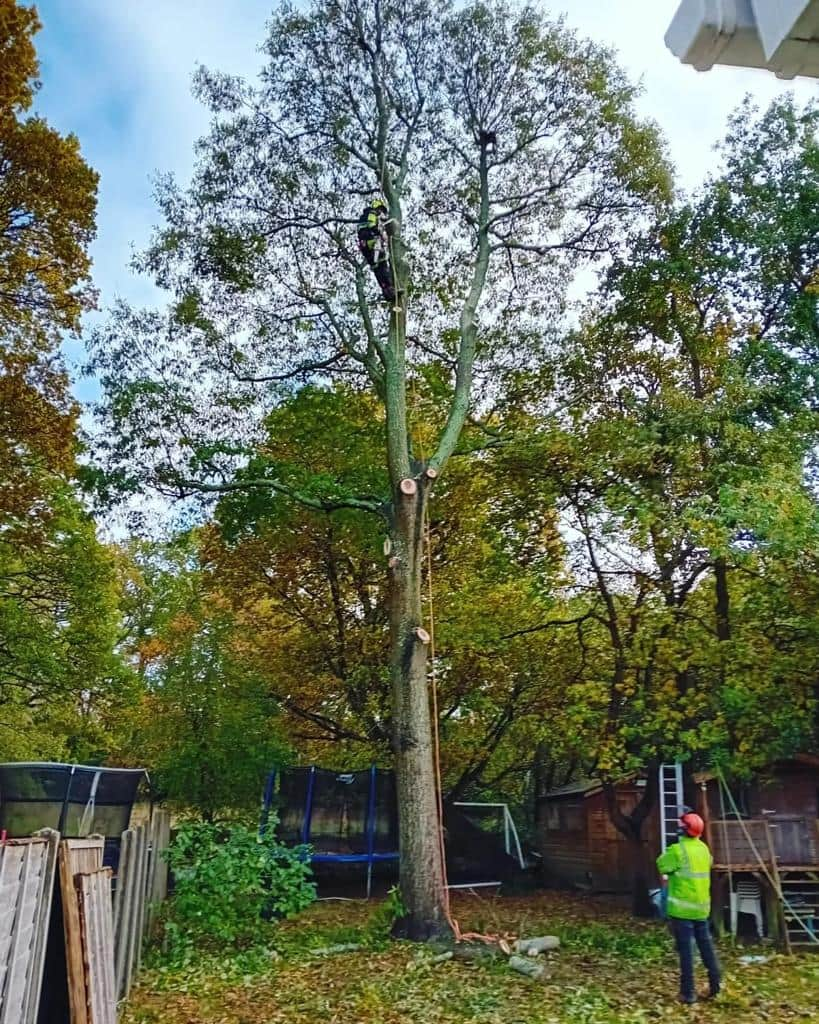
Healthy trees naturally become larger and heavier as they mature. In a spacious environment this growth may cause few difficulties, but trees within residential gardens often have buildings, fences, paths and other features nearby. As branches become longer and crowns become denser, previously manageable trees can begin to outgrow the space available to them. Managing this growth before it creates a significant concern is an important part of responsible tree maintenance.
At NS Tree Surgery Cranleigh, we provide professional tree surgery throughout Cranleigh, Surrey, helping property owners manage established trees through appropriate pruning, crown reduction and other carefully planned tree work. Early intervention can often preserve a tree while preventing its size and structure from becoming increasingly difficult to manage.
Trees Continue to Change as They Mature
A tree that was well suited to a garden when originally planted may eventually become considerably larger than expected. Branches extend further, trunks increase in diameter and the crown develops greater overall mass.
Problems can begin when this growth starts interacting with the surrounding property.
Typical concerns include:
- Branches extending towards buildings
- Heavy limbs overhanging frequently used areas
- Crowns becoming excessively large for their position
- Lower branches obstructing access
- Dense growth reducing useful garden space
- Branches contacting fences or other features
Managing these issues early usually provides more options than waiting until substantial work becomes necessary.
Long Branches Can Become Increasingly Heavy
As branches extend further from the main trunk, their weight and leverage increase. This does not automatically make a branch unsafe, but excessive end weight can become a concern where the branch has structural weaknesses or is exposed to significant movement during strong winds.
Professional tree surgeons assess factors such as:
- Branch length and diameter
- Attachment to the main stem
- Existing cracks or defects
- Dead or damaged sections
- Distribution of weight
- Position above the surrounding property
Where appropriate, selective pruning or crown reduction can help manage excessive growth without unnecessarily removing healthy sections of the tree.
Overgrown Trees Can Interfere with Buildings
Branches growing towards a house or garden structure should ideally be managed before regular contact occurs.
Uncontrolled growth may eventually result in branches reaching:
- Roof coverings
- Gutters
- Windows
- Walls
- Sheds
- Fences
Maintaining suitable clearance helps reduce physical interference while also making future tree maintenance more straightforward.
Dead and Damaged Growth Can Become More Significant
Controlling tree growth is not only about reducing size. Routine tree maintenance also provides an opportunity to identify branches that are dead, damaged or developing poorly.
Dead branches gradually become more brittle and may eventually break away. Damaged branches can also deteriorate following storms or continued movement.
Removing appropriate dead or defective growth can therefore form an important part of preventative tree management.
Crown Reduction Can Keep Mature Trees Manageable
Where an entire canopy has become too large for its surroundings, crown reduction may be appropriate.
Crown reduction involves selectively shortening branches throughout the outer canopy to reduce the overall height, spread or both. When performed professionally, the objective is to create a smaller, balanced crown while retaining an appropriate natural structure.
Crown reduction can be useful where:
- The canopy has become disproportionately large
- Long limbs require careful management
- Greater clearance is needed
- Excessive branch end weight needs reducing
- The tree needs to remain manageable within a restricted space
This can allow an established tree to remain a valuable garden feature rather than waiting until its size creates more substantial difficulties.
Selective Pruning May Be All That Is Required
Not every large tree needs crown reduction. Sometimes only a few individual branches are creating a problem.
Selective pruning may be appropriate for:
- Crossing branches
- Damaged growth
- Deadwood
- Poorly positioned limbs
- Branches extending towards structures
Targeted work allows healthy growth to remain while addressing the specific parts of the tree that require attention.
Lower Branches Can Affect Garden Access
As trees mature, low branches can begin interfering with paths, lawns and other regularly used areas.
Carefully planned crown lifting can increase clearance beneath the canopy by removing selected lower branches. This can improve access and make the space beneath the tree more practical without reducing the entire crown.
As with any pruning, the amount of growth removed should be appropriate for the tree’s size, age and structure.
Dense Crowns Can Affect Light and Garden Use
A large, unmanaged canopy can significantly reduce the amount of light reaching the garden beneath it. Dense growth may also make parts of the outdoor space feel enclosed.
Depending on the tree and its condition, professional pruning can help manage canopy density and improve the relationship between the tree and the surrounding garden.
The aim should not be to remove excessive foliage simply to create more light. Good tree surgery considers how much growth can reasonably be removed while maintaining a suitable crown.
Strong Winds Can Expose Existing Weaknesses
Large trees naturally move in windy conditions. However, excessively long, damaged or poorly balanced branches may experience significant forces during periods of strong wind.
Preventative tree maintenance can identify structural concerns before severe weather exposes them more dramatically.
A professional assessment may identify:
- Cracked branches
- Weak branch unions
- Deadwood
- Unbalanced growth
- Previously damaged limbs
- Excessively long branches
Appropriate management can then be planned before the situation becomes urgent.
Early Tree Management Usually Provides More Options
Waiting until a tree becomes severely overgrown can limit the range of appropriate solutions.
If growth is managed periodically, smaller and more selective pruning operations may be sufficient. Where maintenance is postponed for many years, achieving the desired clearance or size reduction may require substantially more work.
Early management can help:
- Maintain a balanced crown
- Preserve suitable branch structure
- Control excessive size
- Reduce the need for severe pruning
- Identify defects sooner
- Keep the tree appropriate for its surroundings
This preventative approach is one of the main benefits of professional tree maintenance.
Overgrowth Does Not Automatically Mean Tree Felling
A tree becoming too large does not necessarily mean it needs removing. In many situations, professional pruning or crown management can resolve the problem while retaining the tree.
Tree felling is generally considered where removal is genuinely appropriate because of the tree’s condition, structure or suitability for its position.
Assessing the tree before deciding on the work helps avoid unnecessary removal.
Why Professional Tree Surgery Is Important
Managing established trees requires more than cutting branches until the canopy appears smaller. Every cut affects the tree’s structure and future growth.
Professional tree surgeons consider:
- Which branches require attention
- Suitable pruning points
- The amount of growth being removed
- Overall crown balance
- Tree condition
- Future development
This measured approach helps achieve the required result while retaining healthy growth wherever practical.
Why Choose NS Tree Surgery Cranleigh?
At NS Tree Surgery Cranleigh, we provide professional tree surgery, pruning, crown reduction and tree management throughout Cranleigh, Surrey.
Our approach is based on understanding the individual tree and why work is required. Whether a tree needs selective pruning to improve clearance or more comprehensive crown management to control its overall dimensions, we focus on appropriate workmanship that addresses the problem without unnecessary intervention.
Conclusion
Tree growth should be managed before it becomes a significant concern because early intervention usually allows problems to be addressed through more selective and controlled work. Long branches, dense crowns, deadwood and growth extending towards buildings can all become increasingly difficult to manage if allowed to develop unchecked.
Regular professional assessment can identify when pruning, crown reduction or other tree surgery would be beneficial, helping established trees remain appropriate for their surroundings while reducing the likelihood of urgent work later.
If trees at your property in Cranleigh, Surrey are becoming overgrown or beginning to interfere with your garden or surrounding structures, contact NS Tree Surgery Cranleigh. Our team can assess their condition and recommend appropriate tree surgery to keep them carefully managed for the future.
Call us on: 01483 967 989
Click here to find out more about NS Tree Surgery Cranleigh
Click here to complete our contact form and see how we can help with your tree needs.